I had the distinct honor of sharing one of my passions with a friend this weekend. He’s been trying to learn how to rock climb and had been learning indoors. I took him outside for his first time on actual rock. I got a ton of joy out of sharing this passion of mine with someone new. It prompted me to ask: What are you passionate about?
He hesitated, and said he wasn’t sure he was passionate about anything. His reasoning being that he tries not to get obsessive over anything. I scratched my head, as this prompted a bigger question: What is the difference between passion and obsession?
We discussed it for a while with him advocating at first that they were the same. I advocated that there was a fine line between them, but that passion and obsession are very different.
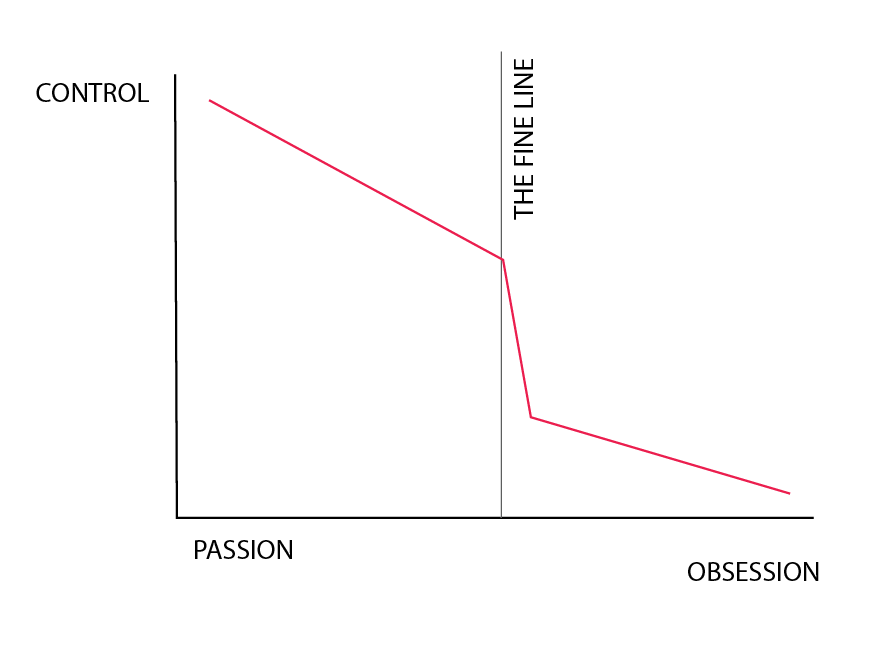
First, let’s define the two on a basic dictionary level.
Passion: “a strong and barely controllable emotion.”
Obsession: “an idea or thought that continually preoccupies or intrudes on a persons mind.”
Immediately, we see the difference being control. Passion is barely controllable, and obsession is uncontrollable. It is a fine line indeed, but there’s more to it on a psychological level. Social psychologist Robert Vallerand defined two different kinds of passion, one of which is the basis for obsession. Harmonious passion is the good kind and obsessive passion is the bad.
Harmonious passion means that you partake in activities that you enjoy, that you find important, and that you spend considerable amounts of time on. The most important aspect of this kind of passion is that you are doing it out of your free will. You can start and stop whenever you want, or whenever it makes sense, and it does not look like an addiction.
For example, a passion for rock climbing may entail spending a few nights a week at the climbing gym, desiring to climb outside on the weekends, spending considerable amounts of money on gear, and looking forward to doing it. Sometimes you won’t go climbing because it’s raining, or you’re too tired, or need to spend extra time with family. This makes sense. Your decision making is in your control and does not take an impact on your positivity or well-being. One of the biggest differences between harmonious and obsessive passion is that the healthy passion means to enjoy an activity for itself. Not for secondary gains. Personally I find this to be true in my own climbing experience. Once I left a long-term relationship I was elated to discover I loved to rock climb for myself, not anyone else.
Obsessive passion would look more like getting upset that you had to break your climbing routine, that it rained out your plans. You’d look for someone to cover a shift at work so you could make up your climbing day, you’d miss your sisters wedding dress fitting because you hadn’t climbed that week, you’d be in a bad mood because you couldn’t climb, you'd hurt yourself to an unnecessary extent…and so on. When your passion is obsessive, you no longer have control over it. You can’t start and stop as you wish. You become addicted to the excitement you get from it. You start prioritizing your passion over other commitments. You can’t stop thinking about it, and it takes a negative toll on you. Obsessive passion creates a hard to resist urge. The urge won’t stop until you give in.
This psychological research made me reflect on my own passions and I must admit… I have let climbing become an obsession at times. I would get frustrated to break my gym routine during the period I had to move out of two different houses in the span of two months. It took a toll on my climbing performance and instead of getting frustrated, I could have approached it from a healthier standpoint had I not been obsessed, but harmoniously passionate about climbing.
What it all boils down to is control. When you cross the line from passion into obsession, you loose control and the lack of the subject robs you of joy. While having passions can be very fulfilling, give meaning to your life, and be a source of joy, it’s good to be mindful of not letting them turn into an obsession.